Computer Engineering
Gebze Technical University

Mohammed Alaklouk

I build simulations and systems in C++.

Intro

Falling-sand physics, digital logic circuits, scroll-driven web experiments. I like understanding how things work deeply enough to rebuild them.

Selected projects

Work

Scree

Falling-sand physics simulator

A falling-sand physics simulator in C++20 and raylib where every pixel is an independent particle which reacts with the materials around it. It runs in the browser via WebAssembly.

  • 30+ materials that spread, burn and dissolve into one another through a tag based reaction system
  • Materials, reactions and physics are defined in editable JSON, and everything can be hot reloaded
  • You can create, edit and delete materials in-app
  • You can import and export your own materials and canvases
  • Bloom lighting for glowing materials

Tech stack

  • C++20
  • raylib
  • Dear ImGui
  • nlohmann/json
  • CMake
  • Catch2
  • Emscripten/WASM

Latch

Logic-gate sandbox & simulator

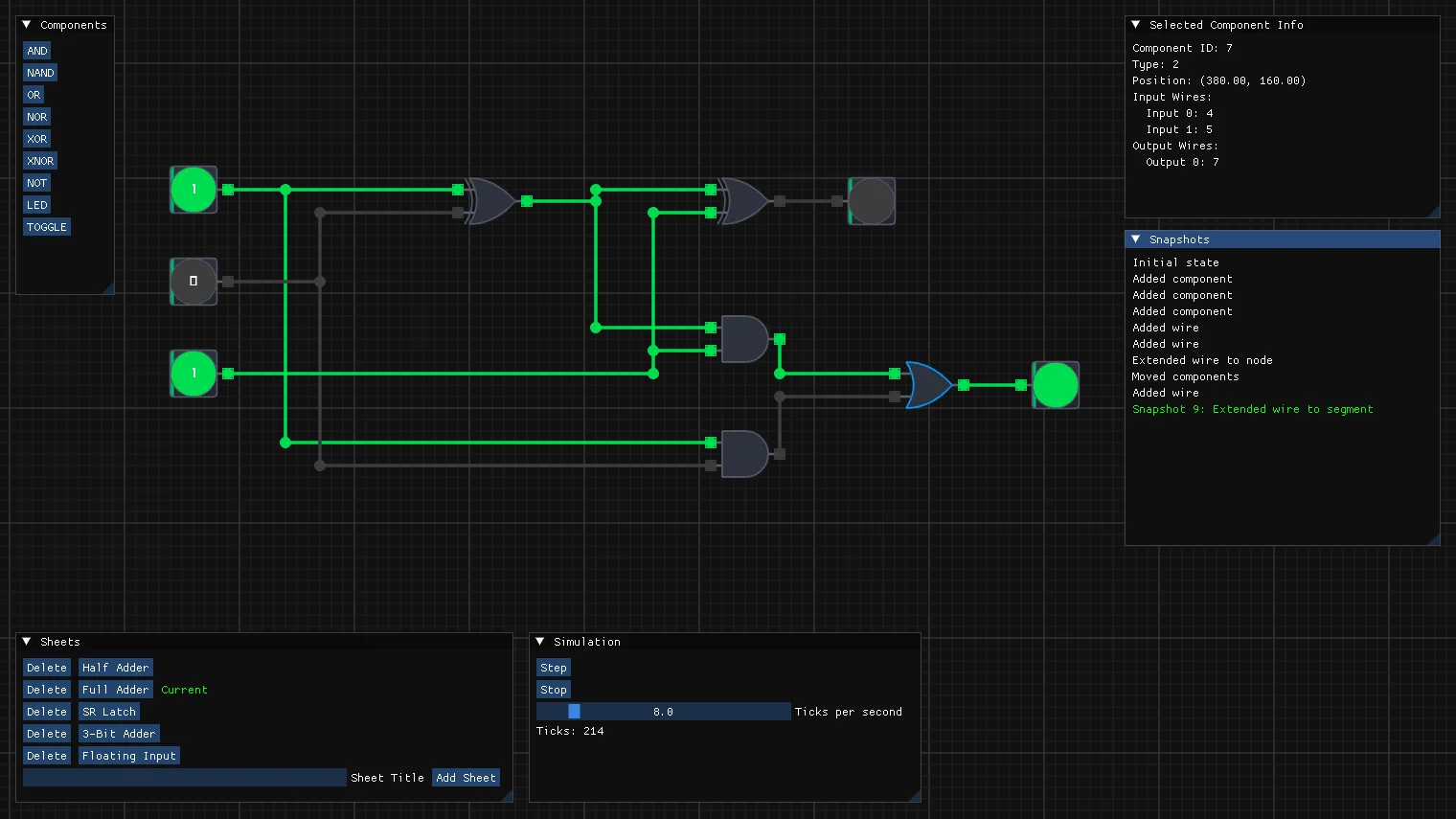
Latch desktop app showing a full adder circuit built from XOR and AND gates, with the component palette, sheets and simulation panels

A logic-gate sandbox and simulator in C++20, raylib and Dear ImGui. You can place gates on an infinite grid, wire them together and simulate the circuit with one-tick propagation delay per gate.

  • Three logic values: LOW, HIGH and UNDEFINED for floating inputs
  • Nine basic gates: AND, OR, XOR and their complements, NOT, a toggle switch and an LED
  • Wires are graphs of nodes and segments which react to node and segment deletion
  • Wires auto-route when extended and reroute when a gate or group of gates is moved
  • Build multiple circuits in the same instance through sheets with a shared component palette and clipboard
  • Canvas selection, copy/paste, delete, and full undo/redo
  • A headless simulation core inside its own static library tested with Catch2

Tech stack

  • C++20
  • raylib
  • Dear ImGui
  • CMake
  • Catch2

The Deep Ocean

Scroll-driven descent to 10,924 m

A recreation of neal.fun's The Deep Sea. A scroll driven descent into the deepest point of the ocean at the bottom of the Challenger Deep at 10,924 m. The site has 128 real sea creatures that fade and blur in and out at their true depths.

  • Features five ocean zones proportionate to their real depth ranges, with a live depth meter and depth markers at the end of each zone
  • Creatures are stored in JSON with their depth, name and X position on the screen
  • A background of bioluminescent particles that move, pulse, die, respawn, and react to scrolling with parallax
  • An animated hero with SVG waves, stylized clouds, a sun and a buoy on the wave's surface
  • Quality of life features like an auto-scroll tour, a zone nav bar and reduced-motion support
  • GSAP ScrollTrigger and Lenis smooth scrolling working together, including on touch devices

Tech stack

  • HTML, CSS, JavaScript
  • GSAP + ScrollTrigger
  • Lenis
  • Canvas 2D
  • GitHub Pages

Who I am

About

I'm a third year computer engineering student at Gebze Technical University. I like to deeply understand how things work, which often leads me to building interactive simulations for them.

I mainly work in C++, and I always prioritize system design. I structure my projects to be flexible and easy to extend as they grow, not just to make them work once. I design systems to be reliable, extendable and efficient.

I also enjoy tinkering with interactive web technologies like GSAP, Lenis and Three.js to build sites that introduce new ways to interact with a page: scroll-driven animations and interactions, as well as 3D.

  • Systems first

    I always prioritize system design. I structure my projects to be flexible and easy to extend as they grow, not just to make them work once.

  • Data, not code

    State lives in plain JSON rather than serialized blobs: easy for users to edit and for the program to read. In Scree, materials are pure data, simple enough that new ones can be generated with AI. Latch is next.

  • Rebuild to understand

    From particle physics to logic gates to the ocean floor: the best way to understand a thing is to simulate it.

Education & toolkit

Background

Degree

BSc Computer Engineering

Gebze Technical University

Time line

Sep 2024

Jul 2028expected

Year of 4 · % complete

GPA
3.55
Languages

Arabic

Native

English

Fluent

Turkish

Conversational

Shipped with

Systems

  • C++ 17/20
  • Emscripten (C++ to web)
  • raylib
  • CMake

Shipped with

Web

  • HTML
  • CSS
  • JS
  • GSAP
  • Lenis

Familiar with

  • OpenGL
  • React
  • Node.js
  • WordPress
  • MongoDB

Contact

Say Hello.

Open to simulation, systems and interactive web work, or just chatting about interesting technologies.